The Cromarty Arts Trust was established in 1987 with the following aims and objectives.
The Cromarty Arts Trust aims to develop appetite and capacity for cultural creativity in individuals and communities in Cromarty and the Black Isle.
We aim to promote the value of creativity and break barriers to participation and interest in all aspects of creative activity.
We will engage with people at an early stage in their experience of creativity to help stimulate a lifelong interest.
We run an annual programme of live music, theatre and performance, music and visual arts workshops, and applied craft courses. Since 1987, we have restored and converted three architecturally important buildings in Cromarty:
The Old Brewery, restored in 1989 and now used for educational courses, accommodation, meetings and workshops.
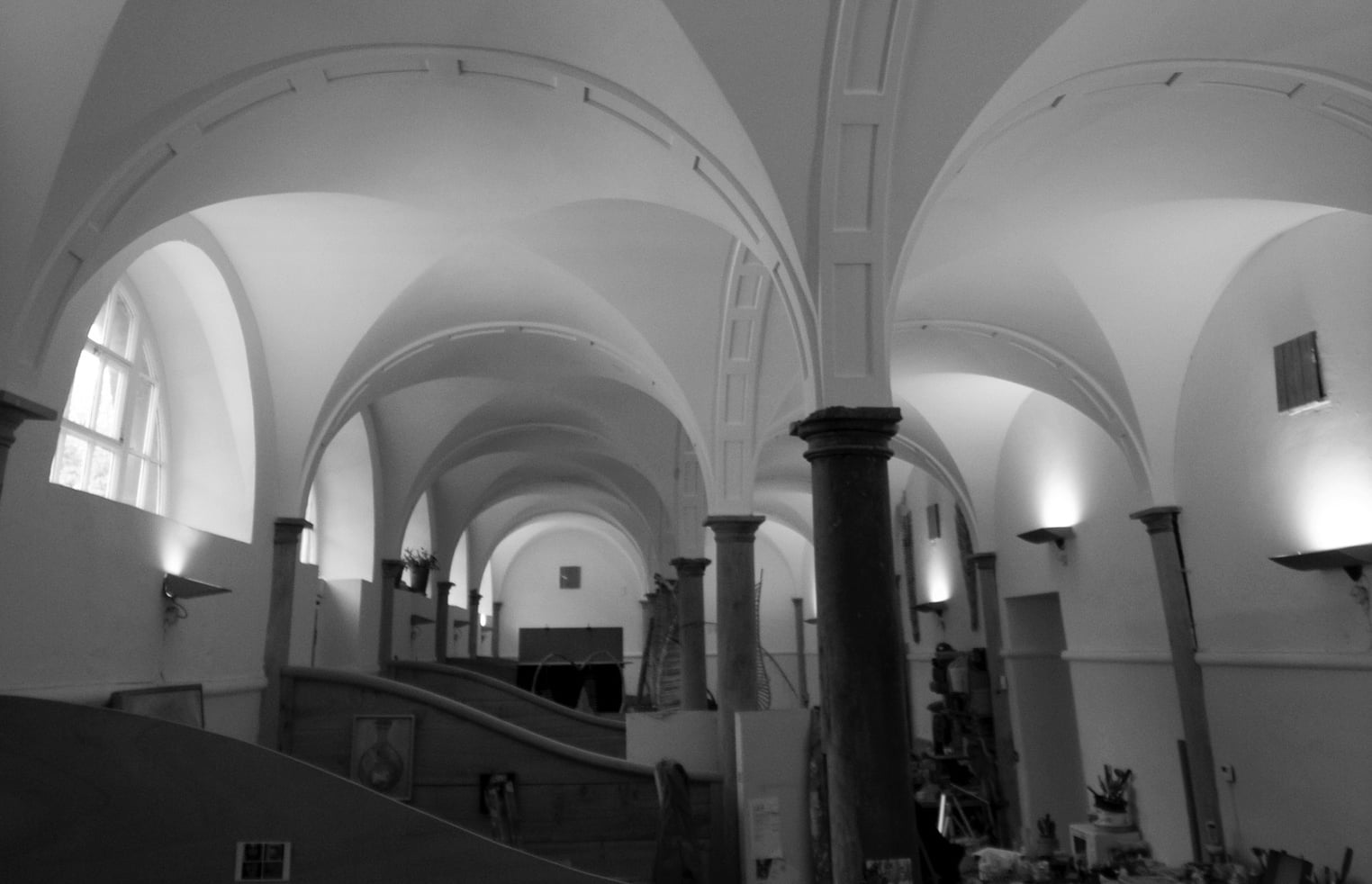
The Stables a Listed Grade A building restored in 1995, now used as a gallery, performance space and artists studios.
Ardyne, a fine example of a merchant’s house restored in 1994, and used as offices and artists accommodation.
Trustees
The Trustees of the Cromarty Arts Trust are volunteers who give their time freely to help with the running and organisation of the charity. The Trustees are: John Nightingale (Chair), Alexander Nightingale, Pat Haynes, Alexander Nightingale, Melanie Riddell and Mary Miers.
The Cromarty Arts Trust is registered as a Scottish charity, number SC003018.
You can download a copy of our most recent Annual Report & Financial Statements here.
FAIR WORK STATEMENT
Cromarty Arts Trust is committed to creating a fair, inclusive and supportive working environment for everyone who contributes to our organisation.
We are guided by the Scottish Government’s Fair Work First principles and believe that people are at the heart of everything we do. We are committed to paying at least the Real Living Wage to our employees, encouraging open communication, supporting learning and development, promoting equality of opportunity and fostering a workplace where everyone is treated with dignity and respect.
As an arts charity, we also recognise the value of artists, freelancers and creative practitioners. We aim to commission work fairly, taking account of recognised sector guidance and recommended rates wherever funding allows, while maintaining transparency about available budgets.
We work collaboratively with our staff, volunteers, trustees, artists and partners to ensure Cromarty Arts Trust remains a welcoming, respectful and rewarding place to work, volunteer and create.
Classes and Courses Payment & Cancellation Policy
A 25% non-refundable deposit is payable on booking. The 75% balance is payable in full one month before the class. It is also possible to pay in installments.
You can cancel your class up to two weeks before the class starts and have the 75% refunded. If you cancel within two weeks of the class/course, we will do our very best to fill your place. If your place is filled, you’ll receive 75% refund. However, if we cannot fill your place we are afraid that there is no refund, unless under exceptional circumstance.
We are a small, non-profit making arts charity and we appreciate your understanding in this matter.
Previous Projects
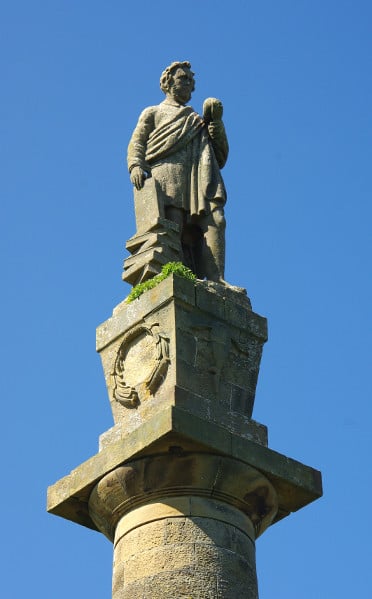
Hugh Miller’s Bicentenary in 2002
The Trust ran a series of projects connected with this event. These included the establishment of both Cromarty and Highland-wide Miller trails with supporting interpretative panels and leaflets; a Hugh Miller exhibition which was shown at museums and libraries throughout Scotland; a series of conferences in Edinburgh and Cromarty, culminating in a major international conference in October 2002. The proceedings were published in two volumes edited by L. Borley: Hugh Miller in Context (2002) and Celebrating the Life and Times of Hugh Miller (2003), both of which can be ordered from the Trust. The latter can also be downloaded here.
The Emigration Stone
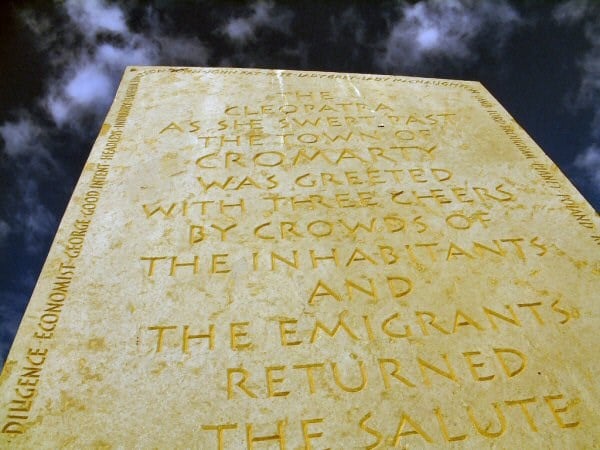
The commission of the Emigration Stone by the stone letter carver Richard Kindersley to commemorate Cromarty’s role as the principal point of embarkation for emigrants who left the Highlands for the New World in the 1830s and 1840s. A 4 metre high Caithness flagstone sited on the Cromarty links, it is inscribed with the words that Hugh Miller used to describe the departure of the Cleopatra from Cromarty in 1831 and the names of the 39 ships known to have left Cromarty for the New World in the 1830s and 1840s.
The Salmon Bothy, Eathie
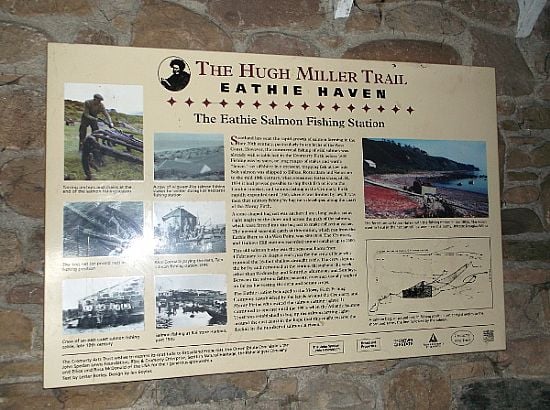
Restored a ruined stone salmon netting bothy beneath the cliffs at Eathie to provide a shelter for walkers and to house information panels on Hugh Miller’s discoveries amongst the fossil beds at Eathie, on the history of salmon netting and on the rich flora and fauna of the surrounding SSSI.